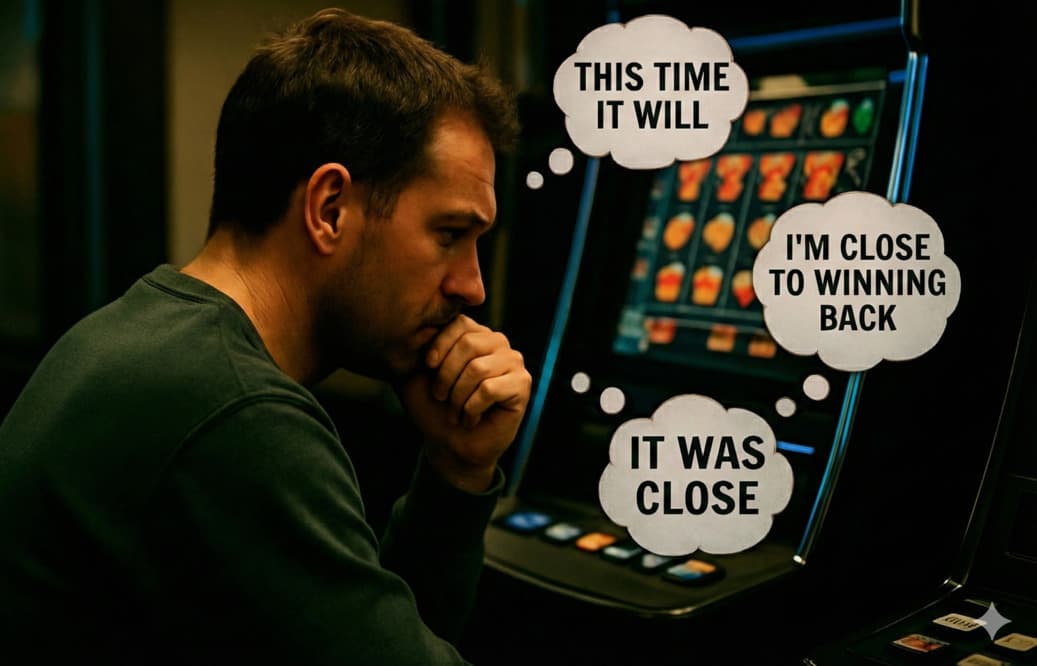
Everyone thinks this way (and that's why it's so dangerous)
It's common for a gambler to think: "I'm on a losing streak, so my luck is about to turn" or "that was close, I'll win next time." The problem isn't just thinking this once. The problem is repeating these thoughts without questioning them, as if they were absolute truths. These are what we call mental traps.
These traps are cognitive distortions – automatic and flawed ways of interpreting what happens around us. They're like tricks the brain uses to maintain gambling behavior, even when it has already caused harm.
What are the most common traps?
Here are some of the most frequent ones:
- Gambler's fallacy: believing that after many losses, the next round has a better chance of being a win (as if the universe had to compensate).
- Illusion of control: thinking you can influence the outcome with certain behaviors (e.g., wearing a lucky shirt, choosing a specific time, performing rituals).
- Selective memory: remembering the wins and forgetting the many losses. This creates a false idea that gambling "works."
- "It was close": interpreting a loss as a sign that you're close to winning, when in reality there's no connection.
- "This is the last time": a promise that repeats every week.
Why does this keep you gambling?
These thoughts function as emotional justifications. They relieve guilt, increase hope, and keep the cycle active. You no longer think about whether gambling makes sense – you just feel that you "need to try one more time."
Identifying these traps is the first step to regaining control. When you can look at a thought and think: "this is just a trick from my mind," it loses its power.
The science behind it
These cognitive distortions have been extensively studied in compulsive gamblers. Research published in the Journal of Gambling Studies showed that gamblers who learn to identify their cognitive distortions are more successful in reducing or quitting gambling[1].
Another study found that simply naming the fallacies (like "gambler's fallacy") can activate brain regions responsible for self-regulation and curb impulsivity[2].
This process is known as cognitive restructuring – a technique used in various behavioral therapies that helps change distorted thoughts into more realistic and healthy interpretations. By practicing this conscious exchange of thoughts, a person strengthens self-control and diminishes the power of addiction.
How to escape these traps
- Create your list of mental traps: Which of these phrases have you already thought?
- Name the thoughts: When a thought comes, label it: "This is the gambler's fallacy."
- Respond with the truth: Replace the thought with a realistic one. E.g.: "Losing 10 times doesn't make the 11th a guaranteed win."
- Remember: it's not just you. All gamblers have been through this. You're not alone.
What about you?
Which of these traps do you most want to learn to disarm? Have you ever stopped to think about which "mental tricks" gambling has taught you to repeat?
Scientific References
[1] Goodie, A. S., MacKillop, J., & Miller, J. D. (2008). Evaluating the South Oaks Gambling Screen with DSM-IV and DSM-5 criteria: Results from a community sample of gamblers. Journal of Gambling Studies, 24(4), 467–480. https://pmc.ncbi.nlm.nih.gov/articles/PMC4504425/
[2] Clark, L., Studer, B., Bruss, J., Tranel, D., & Bechara, A. (2014). Damage to insula abolishes cognitive distortions during simulated gambling. Proceedings of the National Academy of Sciences, 111(16), 6098–6103. https://doi.org/10.1073/pnas.1322295111