Did you know that when you sleep, your body goes through sleep cycles, and each cycle is divided into 4 stages?
Yes, some people think that sleep is just a state where the body is "turned off" and that's it, but that's not quite right. The body goes through cycles that last about 90 minutes, meaning every 1.5 hours we literally wake up and fall back asleep again. Some people don't even notice this happening because it's very quick, while others wake up alert and can't fall back asleep (if you have this type of insomnia, you know what I'm talking about).
And in each cycle, we go through 4 stages, with the body behaving differently in each one.
So, let's look at each sleep stage and cycle
Sleep Stages
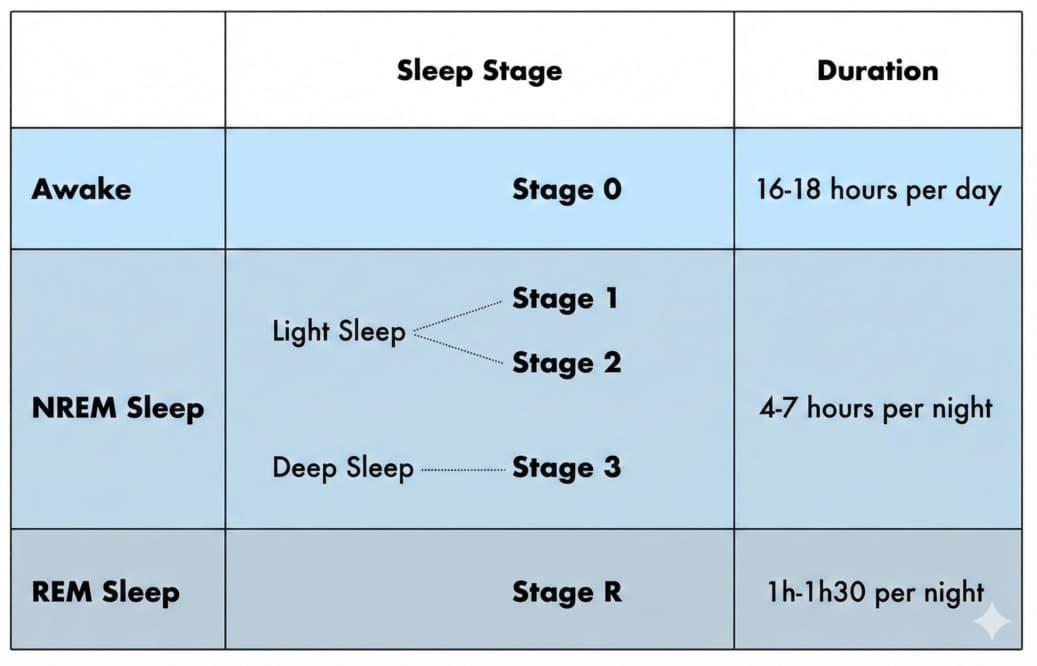
There are four sleep stages: NREM stage 1, NREM stage 2, NREM stage 3, and REM.
The acronyms stand for:
- REM: Rapid eye movement
- NREM: Non-REM
NREM Stage 1
Stage 1 is the lightest stage of NREM sleep. It's a kind of transition between waking and sleeping.
Generally, in this stage, sleep can be easily interrupted, and a person who wakes up during this stage will often claim they never fell asleep.
By the way, have you ever woken up feeling like you were falling? That's one of the possible sensations when you wake up from stage 1!
NREM Stage 2
Stage 2 is the first defined real stage of NREM sleep. Awakenings don't occur as easily as in stage 1 sleep.
In this stage, brain waves continue to slow down, body temperature begins to decrease, and heart rate starts to drop.
NREM Stage 3
Stage 3 is known as deep NREM sleep.
It is the most restorative stage of sleep and consists of delta waves or slow waves.
Awakenings are rare, and it's often difficult to wake someone in Stage 3 sleep.
Parasomnias (sleepwalking or sleep talking) occur during this deepest stage of sleep.
REM
REM sleep, also known as rapid eye movement, is when brain waves are more active than in stages 2 and 3 of sleep.
Awakenings can occur more easily during REM, but being woken during a REM period can leave someone feeling groggy or very sleepy.
REM is usually the last stage of a sleep cycle.
By the way, as my friend Dr. Caio Bonadio correctly points out, many people think REM sleep is deep sleep. This is wrong! Deep sleep is NREM Stage 3.
But what is a sleep cycle?
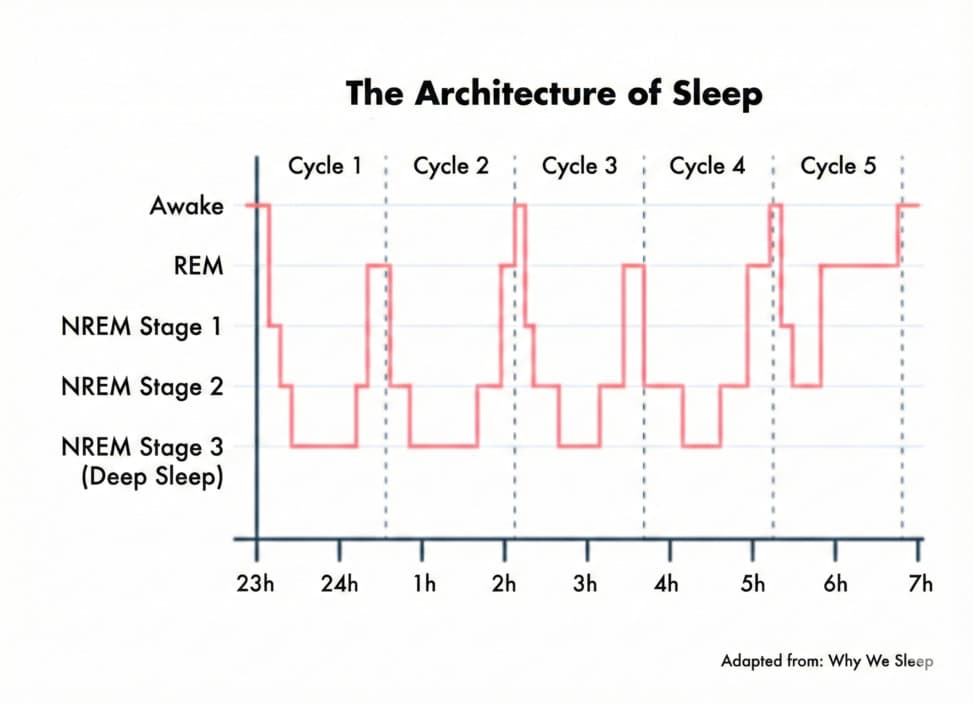
A sleep cycle is the progression through the various stages of NREM sleep to REM sleep before starting the progression again with NREM sleep. A sleep cycle lasts about 90 to 120 minutes, resulting in four to five cycles during a good night's sleep.
However, you don't go directly from deep sleep to REM sleep. Instead, a sleep cycle progresses through the stages of non-REM sleep, from light to deep sleep, and then back to light sleep, ending with time in REM sleep before starting again with light sleep.
Why do people say deep sleep is the most important?
Deep sleep reduces your sleep pressure and provides the most restorative sleep of all sleep stages. That's why if you take a short nap during the day (up to 20 minutes), you'll still be able to sleep at night. But if you nap long enough to fall into deep sleep (more than 30 minutes), you'll have more difficulty falling asleep at night because you've reduced your need for sleep.
During deep sleep, human growth hormone is released and restores your body and muscles from the day's stresses. Your immune system also restores itself. Much less is known about deep sleep than REM sleep. It's believed that during this stage, the brain also refreshes itself for new learning the following day.
In which stages do dreams occur?
Because it's an active sleep state, REM is when the most vivid dreams occur (although it's possible to dream in other stages).
A person can dream 4 to 6 times per night. A French study found that everyone does dream, in fact, even if they don't remember their dreams. However, if awakened during REM sleep, a person usually has better recall of their dreams.
A very interesting fact about REM sleep is that during this stage, there is muscle paralysis. This muscle paralysis occurs as a form of protection, preventing a person from moving in reaction to their dreams.