What is "Sleep Hygiene"?
According to the National Sleep Foundation of the United States:
Sleep hygiene consists of a series of practices and different habits necessary to have good quality sleep and satisfactory alertness during the day (or the period when you are awake, in the case of people who work at night and sleep during the day).
If you haven't yet recognized what Sleep Hygiene is, you've probably already read something on Google like: "The 25 foolproof techniques for sleeping well."
The biggest problem is that there is a lot of information thrown around out of context and without proper clarification, and this can be something very dangerous!
Let me give you an example from a website with sleep hygiene tips that is on one of the first pages of Google:
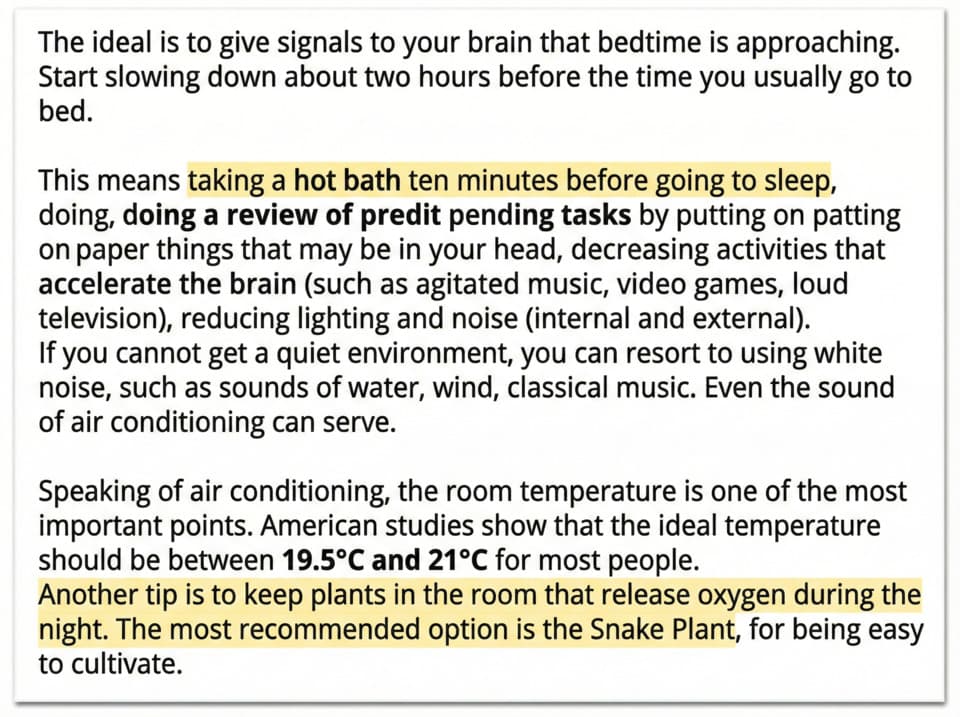
Let's start with the first sentence:
Take a hot bath 10 minutes before bed.
Some considerations:
- Taking a very hot bath can have a similar effect to a cold shower, meaning it can energize and wake up your body. The recommended temperature is between 40ºC and 42ºC1.
- Taking a bath right before bed will probably affect your melatonin production, delaying your sleep and making it even harder for you to fall asleep. The recommendation is that this bath should be 1 to 2 hours before you go to bed1.
Let's look at the last sentence:
Keep plants in the bedroom that release oxygen during the night.
If you look deeper, there are studies that indicate having plants can help with bedroom air purification2, as well as reduce stress levels3.
However, as far as we know, there are no studies demonstrating that plants will actually make you sleep better.
This type of information can lead a person to:
- Believe that a plant will make a big difference in their sleep
- Trigger the opposite feeling, that if even after spending money on this it didn't solve the problem, there's nothing else to be done.
What we want to say with the two examples above is not that you shouldn't follow these recommendations. We just want to create awareness that some of these suggestions have very low relevance, and it's always good to understand what's behind each of these "foolproof techniques," to ensure that you will follow them properly, and with the appropriate expectation of how much they can help your sleep. (Note: if you're going to apply this tip, remember that not every plant releases oxygen during the night)
Sleep Hygiene at Vigilantes do Sono
It's for these and other reasons that here at Vigilantes do Sono we are very careful when we talk about Sleep Hygiene.
Now, adhering to good practices is important to complement the CBT-I program.
That's why we're going to adopt a concise flow of the most important tips you need to know to sleep better, always with:
- Precise explanations of how to put a particular tip into practice;
- Explaining how effective it is in helping you sleep better (we don't want to create false expectations);
- Showing what scientific evidence supports that tip.
For this reason, we will adopt a flow with the following topics to be reviewed during the program4:
Sleep Hygiene - Part 1: Homeostasis, bedtime schedules, and physical exercise
Sleep Hygiene - Part 2: Exercise alternatives and bedroom environment
Sleep Hygiene - Part 3: Meals, liquids, and caffeine
Sleep Hygiene - Part 4: Alcohol and nicotine
Sleep Hygiene - Part 5: Clock watching and naps
Want to know more about each of these topics?
That will be covered in the next session!
- https://www.sciencedaily.com/releases/2019/07/190719173554.htm e https://time.com/4665489/hot-shower-before-bed/↩
- https://ntrs.nasa.gov/archive/nasa/casi.ntrs.nasa.gov/19930073077.pdf↩
- https://jphysiolanthropol.biomedcentral.com/articles/10.1186/s40101-015-0060-8↩
- https://www.springer.com/gp/book/9780387222523↩