It would be great to think that poor sleep has a single cause! Unfortunately, it's not that simple. In most cases, insomnia reflects a combination of circumstances.
How insomnia develops: the "3Ps" model
In the 1980s, a psychologist named Dr. Spielman created a model to explain how insomnia develops and why it doesn't disappear quickly. This model became known as the "3 Ps" model and is currently the most widely used model by healthcare professionals for insomnia assessment.
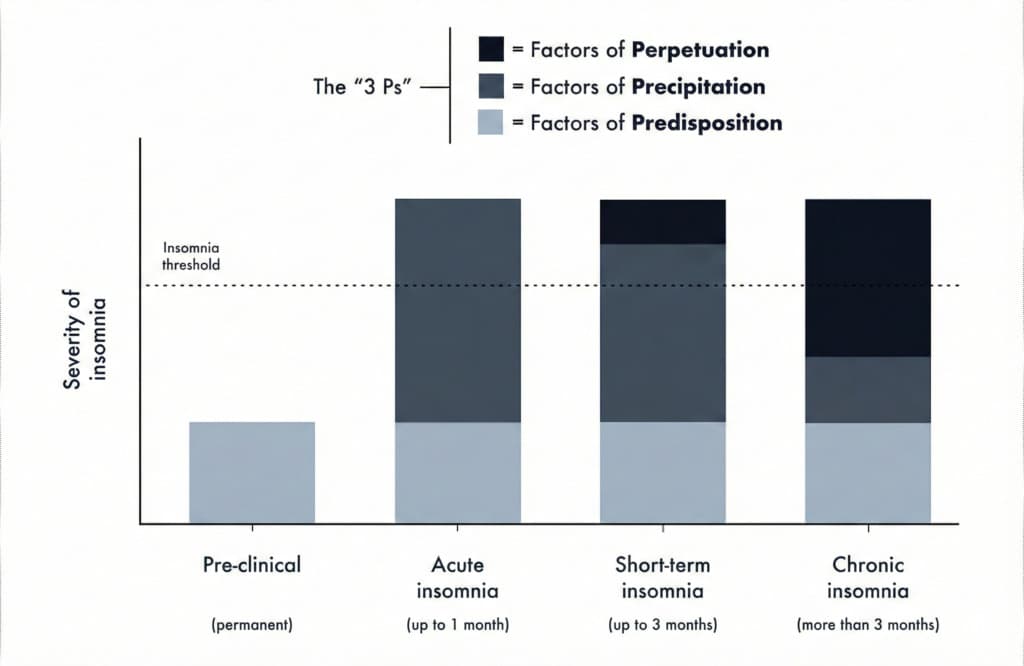
Figure: Nature of insomnia over time (Spielman's 3Ps Model 1987).
- The first P in the "3 Ps" model stands for Predisposition. Predisposition is often related to a family history of difficulty sleeping. Beyond hereditary factors, other predisposing factors can include things like: being the type of person who tends to worry a lot, or simply never having been what we commonly call a "good sleeper." However, predisposing factors alone generally don't justify the onset of insomnia.
- The second P stands for Precipitation, also called triggering factors. Many people begin experiencing difficulty sleeping as a result of one or more life changes that end up triggering insomnia. These changes can be positive: planning a wedding, the birth of a baby, moving to a new home - or negative: developing another illness, a period of family conflict, losing a job. All changes cause stress and, during stressful times, people have more difficulty sleeping.
- The third P stands for Perpetuation. To try to resolve insomnia, most people develop bad habits that end up making the sleep problem continue, even after the issue that started it all has been resolved. In other words, they perpetuate the insomnia.
Bad habits that perpetuate insomnia
These habits are usually divided into two:
- Excessive time in bed; and
- Engaging in activities unrelated to sleep in the bedroom.
Excessive time in bed means spending more time in bed than necessary. This happens when you go to bed earlier, get out of bed later, or take naps. Although these ideas make sense (after all, by spending more time in bed you increase your chance of sleeping more, right?) they have a problem because being able to sleep is one thing and actually falling asleep is another. And if "being able to" and "actually doing it" are very different, over time you create in your mind (without realizing it) the idea that your bed is the place where you try to sleep and can't. Gradually this becomes true, and eventually the bed really becomes this place where you can't sleep. By doing this, you unintentionally perpetuate insomnia. To address this situation, we will use the sleep restriction technique.
Engaging in activities unrelated to sleep in the bedroom includes various activities that a person ends up doing, such as working, eating, watching television in the bedroom/bed environment. They end up stimulating you to stay awake and at the same time build in your mind (without you realizing it) the idea that the bed is not necessarily a place for sleeping. This can also be adjusted, and for that we will use the stimulus control technique.

So, as you can see in the "3 Ps" model, insomnia usually appears in people who already naturally had some difficulty sleeping, but only manifests during times of greater worry and stress in the person's life. Over time, certain habits can perpetuate the insomnia condition.
How to know if insomnia is chronic
One way to identify when insomnia begins to become chronic is when there's a vicious cycle that seems to develop a "life of its own." At this point, the external change that caused the onset of insomnia no longer exists with such intensity, and the difficulty sleeping itself becomes a focus of worry and stress. For example, thoughts like: "if I don't fall asleep soon, I won't be able to handle my tasks tomorrow" can lead to anxiety and frustration. This vicious cycle, combined with misguided strategies to try to sleep more in the short term, tends to make things worse.
At this point you might be thinking, "What an unfair life, I know people who do everything wrong and just because they don't have the predisposition factor, they simply sleep really well." It's true, this does happen, but we have to look on the bright side. Thanks to scientific advances, we now know what causes insomnia and what we need to do to reverse it.
What to do at each stage of insomnia
- If you are still in an acute or recent stage of insomnia (usually up to 1 month), a cause-and-effect relationship is common. Once the external event causing heightened arousal, worry, or stress is relieved, sleep improves.
- If you are in a short-term insomnia stage (usually up to 3 months), it's important that you understand which strategies you may be adopting to improve sleep in the short term but that are inappropriate and may worsen insomnia further.
This program can help you with these aspects, and you will probably see quick results in sleep improvement. - If you are in a chronic insomnia stage (usually more than 3 months), it's even more important that you understand which behaviors and thoughts are perpetuating your insomnia.
It is in this chronic scenario that cognitive behavioral therapy for insomnia (CBT-I) proves to be even more appropriate. CBT-I directly addresses the mental and behavioral aspects of sleep. It will help you think and behave differently, which will break these vicious cycles and unhealthy habits. And in the end, you should once again have healthy, well-regulated sleep.