Sleep is a basic human need. It is so important that humans can survive longer without food than without sleep.
Despite decades of study, scientists still don't know all the functions of sleep or the exact reasons why people sleep. There are many theories: sleep helps us conserve energy, erase and create memories, develop stronger bodies, or eliminate toxins from the brain. The thing is, all sleep theories so far fail to explain everything, especially extreme cases.
The good news is that, although there are still many mysteries surrounding sleep, we also already know a lot and understand well the fundamental mechanisms that make us want to sleep. Understanding some of these physiological processes will be essential for you to overcome insomnia.
The main mechanisms that make a person feel sleepy are:
- Sleep pressure
- Circadian rhythms (regulated by our biological clock)
Sleep Pressure
Sleep pressure is the force that makes you sleepier the longer you stay awake.
To make it easier to understand, think of it like hunger. When you've just eaten, you have little hunger, but the longer you go without food, the hungrier you get.
Similarly, sleep pressure increases progressively from the moment you wake up and quickly recovers when you sleep (just like when you eat, you stop feeling hungry).
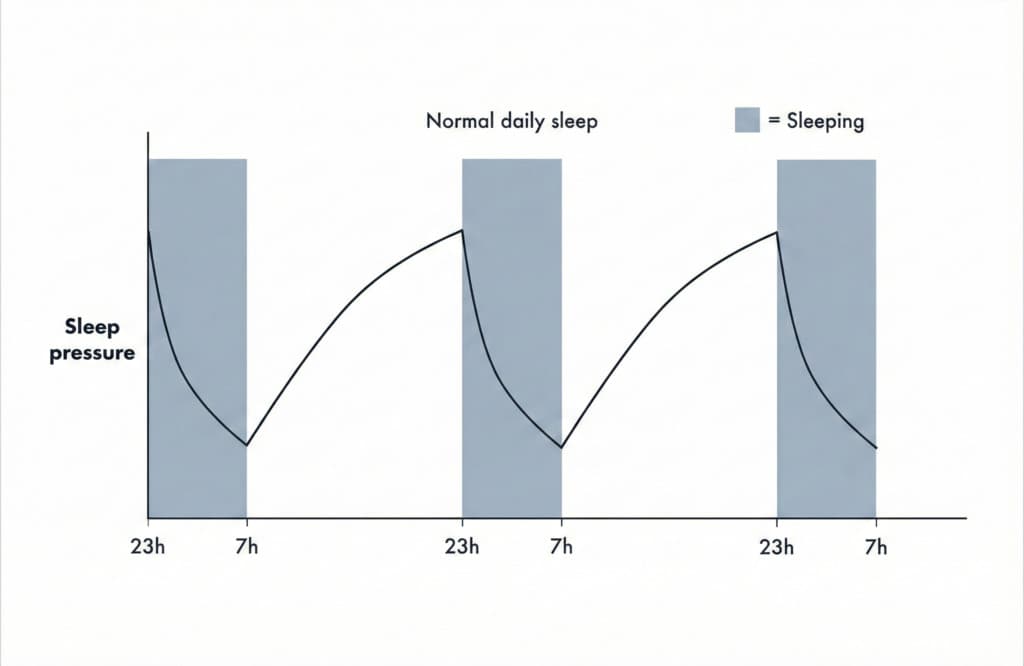
How do you know it exists?
When you experience two extremely poor nights of sleep, you will feel very sleepy. On the third day when you go to bed, you will have an easier time falling asleep, at least in theory.
How to use it in your favor?
When we talk in detail about the Sleep Restriction technique, we will teach you how to use this sleep pressure to your advantage to sleep better!
Circadian Rhythms
Our biological clock is located roughly in the middle of the brain, in an area called the suprachiasmatic nucleus. This nucleus is a timing system that anticipates and prepares the body for environmental variations, that is, it uses these environmental variations - such as sunrise and sunset - as cues to synchronize physiological activities and determine our sleep and wake times. These environmental cues, in addition to the amount of light you're exposed to, also include your meal times, your work schedule, study time, exercise, and all the activities you do during the day.
Using such cues, the biological clock regulates circadian rhythms, which are those that repeat and vary approximately every 24 hours, around one day. Our main circadian rhythm is the sleep-wake cycle.
One of the most interesting aspects of circadian rhythms are the changes that occur in the body throughout the day. For example, to prevent bedwetting, our clock helps program kidney function, based on environmental time cues, to decrease nighttime urine production!
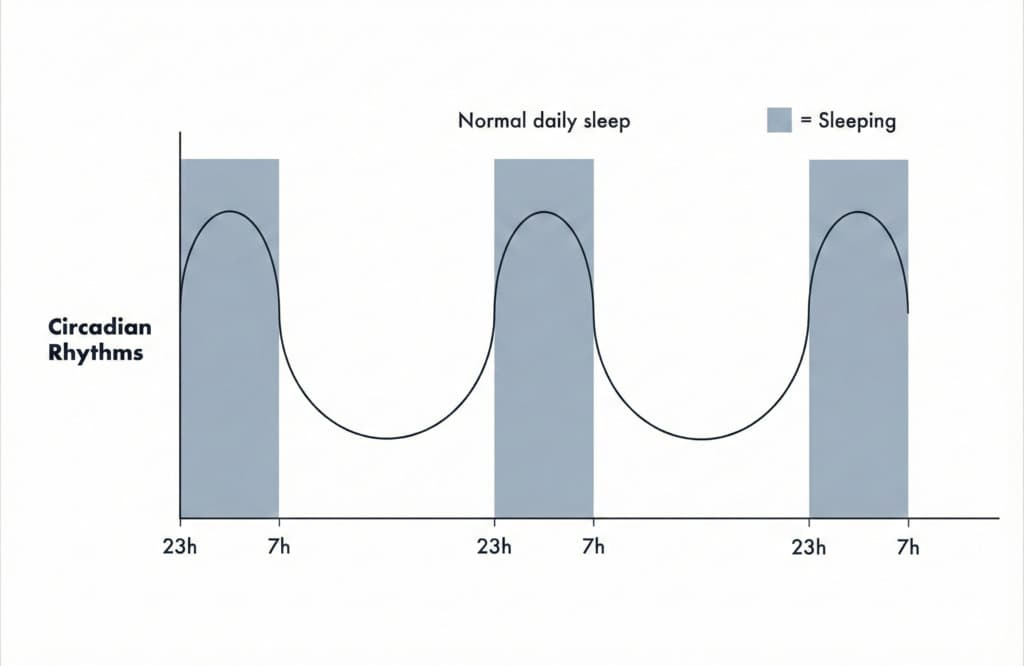
How do you know it exists?
In a dark environment, your body understands that night is approaching, and this is a cue for your body to prepare for sleep. Have you ever noticed that you often feel sleepy when you start watching a movie with the living room lights off?
How to use it in your favor?
We will discuss later in our program how to adopt practices such as light exposure, and even melatonin supplementation, to use the circadian rhythm in your favor against insomnia.
While sunlight, or the light-dark cycle, is the main external (exogenous) synchronizer of our sleep-wake cycle, melatonin is a hormone and our main internal (endogenous) synchronizer. Melatonin also adjusts a series of other functions that scientists have barely begun to understand.
Therefore, in any case, here's a note: there is still controversy regarding the widespread use of melatonin, and it is always advisable to have medical supervision or guidance from a specialist before taking it. It is a hormonal treatment with very specific indications, and guess what? Insomnia is not necessarily one of them.
Final Comments
I know this content doesn't seem very practical, but this knowledge already helps us start questioning some things in our daily lives that are important for better understanding the techniques in this program and encouraging some behavioral changes.
Here are some questions for you to reflect on:
- Does it make sense to go to bed without feeling sleepy to try to sleep more? Would you sit at the dinner table waiting to get hungry? So why wait to feel sleepy in bed?
- What can I do during the day to increase "sleep pressure" at night?


