Catastrophic Thoughts
You've probably experienced this. We all have. Catastrophic thoughts are false thoughts we assume about ourselves and the world around us. They are irrational thoughts and beliefs that we unknowingly reinforce over time.
Because they are regular everyday thoughts, it's quite difficult to recognize and deal with them. Additionally, they often pop into our heads without us thinking about them.
They can be about anything in your life, but let's focus on our case of insomnia. You might lie awake at night when you suddenly think:
"I can't survive without 7 hours of sleep."
This is an example of a catastrophic thought.
The biggest problem with these thoughts is that they tend to arise at a moment when you already don't want to have thoughts. This prevents you from relaxing, making it harder to fall asleep.

What can you do about catastrophic thoughts, if they pop into your head without you thinking about them, and the more you try not to think about them, the more they bother you?
The first step is to recognize what these thoughts are.
Types of catastrophic thoughts
Below, you'll see a list of the main types of catastrophic thoughts that can affect sleep.
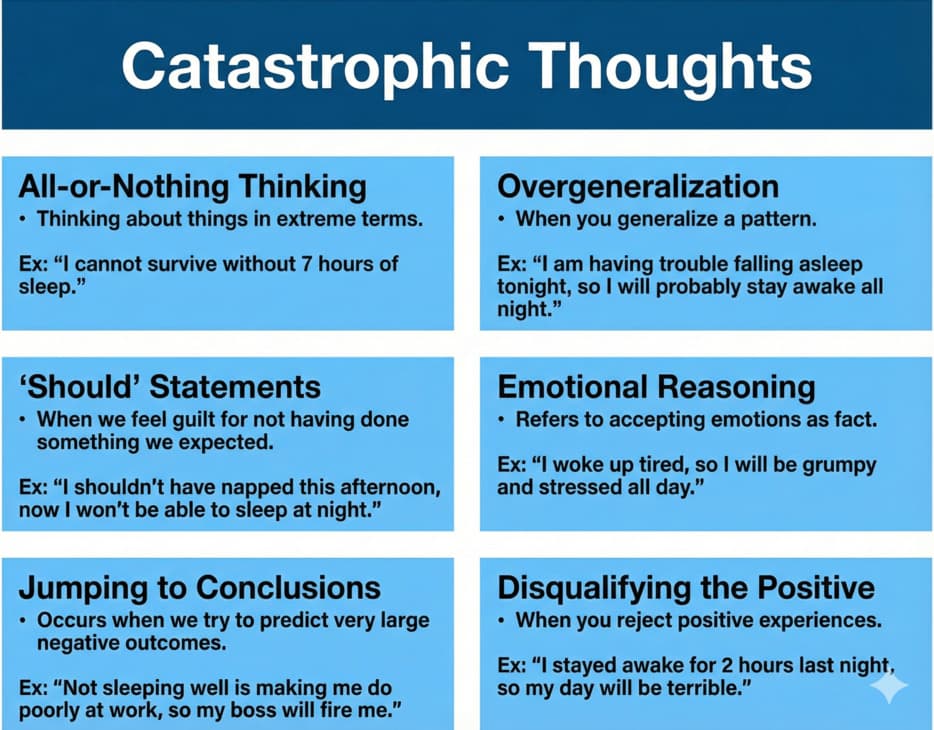
But if these thoughts won't leave my head, how can I deal with them?
A good solution is to challenge them in a logical and objective way!

How to challenge catastrophic thoughts
Just follow a very simple step-by-step process:
- Identify whether the thought is a fact or an opinion
- Categorize it (should statements; disqualifying the positive; overgeneralization; all-or-nothing thinking; emotional reasoning; jumping to conclusions)
- Reframe them in a logical and objective way
Identify whether the thought is a fact or an opinion
As silly as it may seem, we first need to identify whether what we're thinking is a fact or an opinion.
A fact is unchangeable. It's something you saw, read, or heard. An opinion, on the other hand, is a judgment; it's something that can vary from person to person.
Facts are established, so if they've already happened, you don't need to worry about them (as far as I know, we can't change the past).
Opinions are more dangerous because they can be exaggerated. And it's these opinions that we'll need to recognize.
Let's try to illustrate them:
- I delivered a terrible project at work → this is an opinion (needs to be addressed)
- I delivered a project and my boss said it was bad → this is a fact (doesn't need to be addressed)
The danger with this second thought is the opinions that arise from it, such as:
- My boss doesn't like me, he's going to fire me → this is an opinion (needs to be addressed)
Categorize the type of catastrophic thought
I delivered a terrible project at work → All-or-Nothing Thinking
My boss doesn't like me, he's going to fire me → Jumping to Conclusions
Reframe them in a logical and objective way
I delivered a terrible project at work
↓
I delivered a project at work that didn't meet my expectations, but considering the time I had and the conditions, it's within what could be expected.
My boss doesn't like me, he's going to fire me
↓
My boss didn't like the work I delivered. Him not liking the work doesn't mean he doesn't like me. I can better understand what displeased him and show better results next time.
How to put this step-by-step process into practice?
There are many catastrophic thoughts we can have. Stopping to think about all of them at once can be very taxing, and many times you'll only remember them when you're in bed.
We suggest you stop to think about AND WRITE DOWN one catastrophic thought per day. After a few days, you should have encountered the main thoughts that torment you most in bed, and this should help you feel more relaxed.
You can make these notes on paper, following a format similar to the table below:
| Day | Thought | Category | Reframing | | ------ | ---------------------------------------- | -------------- | ------------------------------------------------------------------------------------------------------------ | | 1 | I can't survive without 6 hours of sleep | All-or-nothing | There's a good chance I'll be tired tomorrow if I don't sleep 6 hours. It's not easy, but I can handle it. | | 2 | | | | | 3 | | | | | ... | | | |
OR if you prefer, here at Sleep Guardians we have a tool that helps you with exactly this, but it's up to you to choose where to make your notes—the most important thing is to practice every day.
You'll see! After practicing for a few days, you'll have really trained your brain to process such thoughts, and suddenly you'll be able to deal with them much faster. Then you won't worry about them as much.


